What Makes Each Handcrafted Glass Lamp One of a Kind?
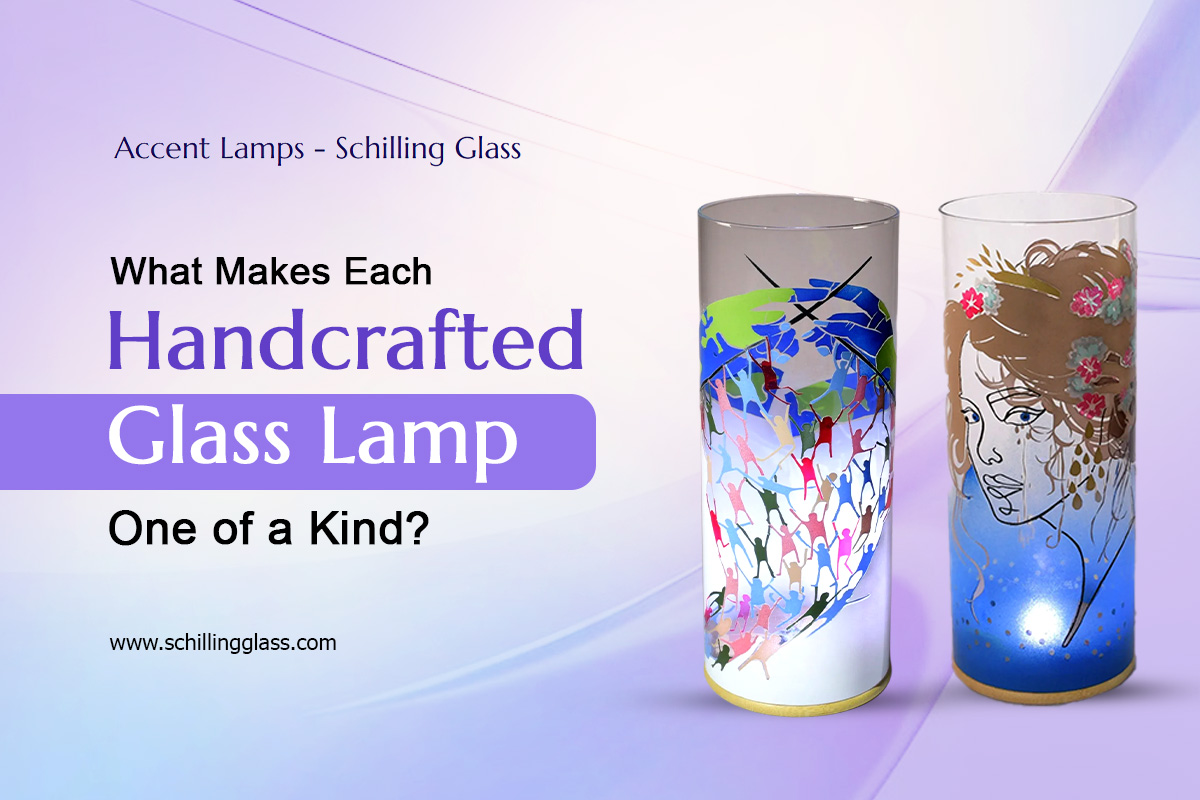
There’s something quietly compelling about a lamp that feels alive with color and movement. At Schilling Glass, every piece begins as clear glass and ends as a singular work of light-based art, shaped through a process that allows no repeats. This approach is what defines our custom-made glass lamps, where no two outcomes are ever the same.
Clear Glass Sets the Rules
Each accent lamp starts as a smooth glass cylinder with no edges, corners, or frames. That detail matters. Without edges to stop the eye, images wrap, shift, and merge. The front and back of the lamp are visible at once, allowing colors and shapes to recombine as the viewer moves around it. Clear glass isn’t just a surface here—it’s an active part of the palette, influencing how patterns transform and interact under light.
Powder Glazing Changes Everything
Rather than using liquid paint, etching, or printing, these lamps are created using powder glazing—a material first developed in 1945 and now widely used on metal surfaces for its durability. At Schilling Glass, that material is applied to glass using electrostatic charge, without solvents or fluids. The powder is blown in a fine cloud toward the glass, where it’s drawn in by an opposing charge created through a copper-lined inner sleeve.
Once applied, the powder is heat-cured in an oven, transforming it into a permanent glaze. This step-by-step method is more like ceramics than painting, but at much lower temperatures.
One Color at a Time, With No Shortcuts
Applying each color on an accent lamp requires its own full cycle: high-temperature tape as a stencil or masking, applying the powder, curing, and drying. Planning the sequence matters because once a glaze is cured, it cannot be changed. As new colors are added, earlier layers are carefully protected by masking. This is where time and patience shape the final piece. An accent lamp with multiple colors can demand close to ten days to complete. Unlike ceramics, even a small shift in this cycle affects the outcome.
This layered process is also what allows each designer glass lamp to carry depth instead of surface decoration. The result isn’t flat color—it’s dimensional, with shadows and overlaps that only appear once the lamp is lit.
When Light Becomes Part of the Design
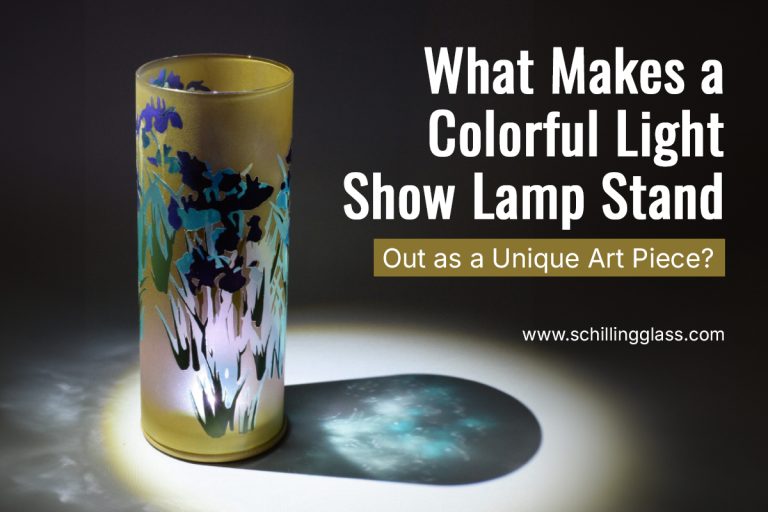
An LED housed in the base activates a new dimension. When illuminated, the lamp projects a tapestry of color and shadow onto surrounding walls and surfaces. Because the glass remains transparent in places and opaque in others, light passes through differently across the cylinder. Unlike a two-dimensional art piece, the entire image shifts depending on your specific point of view. Each lamp feels constantly in motion.
This interaction between material and light is what defines our designer LED lamp concept. Each lamp isn’t just an object, but a source of evolving visual rhythm.
Why No Two Lamps Can Ever be Identical
Every lamp is shaped primarily by the creativity of the artist. Temperature control, electrostatic charge, the choice of powder, these are the tools in his hand. The absence of liquid paint, the reliance on masking and curing, and the unique behavior of individual powders as they glaze onto curved glass, all lend to the individuality of each lamp. Our custom-made glass lamps are not produced in series, and never will be.
A Final Thought on Craft and Light
The techniques for creating individual lamps are perfected through repetition. Only the artists’ techniques are replicated. The tools may stay the same, but the results never do. That’s what makes every designer glass lamp from Schilling Glass a singular piece, defined by creativity and process while finally shaped by light.